class Allomorph is Str { }
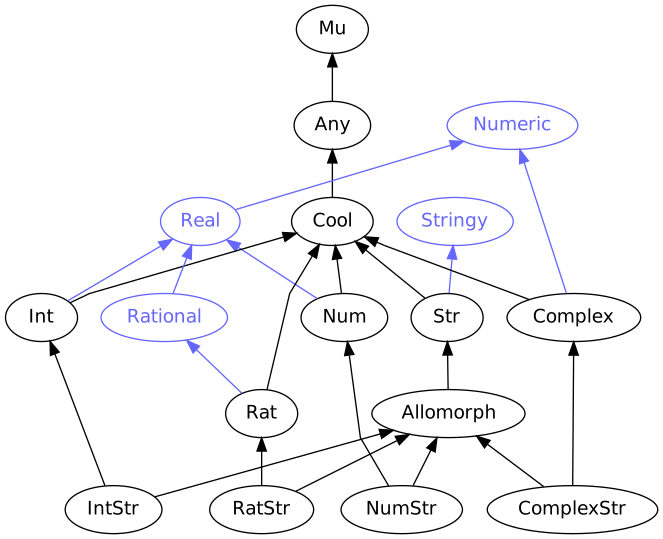
The Allomorph class is a common parent class for Raku's dual value types: ComplexStr, IntStr, NumStr, RatStr.
The dual value types (often referred to as allomorphs) allow for the representation of a value as both a string and a numeric type. Typically they will be created for you when the context is "stringy" but they can be determined to be numbers, such as in some quoting constructs:
my $c = <42+0i>; say $c.^name; # OUTPUT: «ComplexStr» my $i = <42>; say $i.^name; # OUTPUT: «IntStr» my $n = <42.1e0>; say $n.^name; # OUTPUT: «NumStr» my $r = <42.1>; say $r.^name; # OUTPUT: «RatStr»
As a subclass of both a Numeric class and Str, via the Allomorph class, an allomorph will be accepted where either is expected. However, an allomorph does not share object identity with its Numeric parent class- or Str-only variants:
my ($complex-str, $int-str, $num-str, $rat-str) = < 42+0i 42 42e10 42.1 >; my (Complex $complex, Int $int, Num $num, Rat $rat) = $complex-str, $int-str, $num-str, $rat-str; # OK! my Str @strings = $complex-str, $int-str, $num-str, $rat-str; # OK! # ∈ operator cares about object identity say 42+0i ∈ < 42+0i 42 42e10 42.1 >; # OUTPUT: «False» say 42 ∈ < 42+0i 42 42e10 42.1 >; # OUTPUT: «False» say 42e10 ∈ < 42+0i 42 42e10 42.1 >; # OUTPUT: «False» say 42.1 ∈ < 42+0i 42 42e10 42.1 >; # OUTPUT: «False»
Please see the Numerics page for a more complete description on how to work with these allomorphs.
Methods§
method ACCEPTS§
multi method ACCEPTS(Allomorph:D: Any:D \a)
If the a parameter is Numeric (including another allomorph), checks if invocant's Numeric value ACCEPTS a. If the a parameter is Str, checks if invocant's Str value ACCEPTS a. If the a parameter is anything else, checks if both Numeric and Str values of the invocant ACCEPTS a.
say "5.0" ~~ <5>; # OUTPUT: «False» say 5.0 ~~ <5>; # OUTPUT: «True» say <5.0> ~~ <5>; # OUTPUT: «True»
method Bool§
multi method Bool(::?CLASS:D:)
Returns False if the invocant is numerically 0, otherwise returns True. The Str value of the invocant is not considered.
Note: For the Allomorph subclass RatStr also see Rational.Bool.
method chomp§
method chomp(Allomorph:D:)
Calls Str.chomp on the invocant's Str value.
method chop§
method chop(Allomorph:D: |c)
Calls Str.chop on the invocant's Str value.
method comb§
method comb(Allomorph:D: |c)
Calls Str.comb on the invocant's Str value.
method fc§
method fc(Allomorph:D:)
Calls Str.fc on the invocant's Str value.
method flip§
method flip(Allomorph:D:)
Calls Str.flip on the invocant's Str value.
method lc§
method lc(Allomorph:D:)
Calls Str.lc on the invocant's Str value.
method pred§
method pred(Allomorph:D:)
Calls Numeric.pred on the invocant's numeric value.
method raku§
multi method raku(Allomorph:D:)
Return a representation of the object that can be used via EVAL to reconstruct the value of the object.
method samecase§
method samecase(Allomorph:D: |c)
Calls Str.samecase on the invocant's Str value.
method samemark§
method samemark(Allomorph:D: |c)
Calls Str.samemark on the invocant's Str value.
method split§
method split(Allomorph:D: |c)
Calls Str.split on the invocant's Str value.
method Str§
method Str(Allomorph:D:)
Returns the Str value of the invocant.
method subst§
method subst(Allomorph:D: |c)
Calls Str.subst on the invocant's Str value.
method subst-mutate§
method subst-mutate(Allomorph:D \SELF: |c)
Calls Str.subst-mutate on the invocant's Str value.
method substr§
method substr(Allomorph:D: |c)
Calls Str.substr on the invocant's Str value.
method substr-rw§
method substr-rw(Allomorph:D \SELF: $start = 0, $want = Whatever)
Calls Str.substr-rw on the invocant's Str value.
method succ§
method succ(Allomorph:D:)
Calls Numeric.succ on the invocant's numeric value.
method tc§
method tc(Allomorph:D:)
Calls Str.tc on the invocant's Str value.
method tclc§
method tclc(Allomorph:D:)
Calls Str.tclc on the invocant's Str value.
method trim§
method trim(Allomorph:D:)
Calls Str.trim on the invocant's Str value.
method trim-leading§
method trim-leading(Allomorph:D:)
Calls Str.trim-leading on the invocant's Str value.
method trim-trailing§
method trim-trailing(Allomorph:D:)
Calls Str.trim-trailing on the invocant's Str value.
method uc§
method uc(Allomorph:D:)
Calls Str.uc on the invocant's Str value.
method WHICH§
multi method WHICH(Allomorph:D:)
Returns an object of type ValueObjAt which uniquely identifies the object.
my $f = <42.1e0>; say $f.WHICH; # OUTPUT: «NumStr|Num|42.1|Str|42.1e0»
Operators§
infix cmp§
multi infix:<cmp>(Allomorph:D $a, Allomorph:D $b)
Compare two Allomorph objects. The comparison is done on the Numeric value first and then on the Str value. If you want to compare in a different order then you would coerce to a Numeric or Str value first:
my $f = IntStr.new(42, "smaller"); my $g = IntStr.new(43, "larger"); say $f cmp $g; # OUTPUT: «Less» say $f.Str cmp $g.Str; # OUTPUT: «More»
infix eqv§
multi infix:<eqv>(Allomorph:D $a, Allomorph:D $b --> Bool:D)
Returns True if the two Allomorph $a and $b are of the same type, their Numeric values are equivalent and their Str values are also equivalent. Returns False otherwise.
Typegraph§
Allomorph